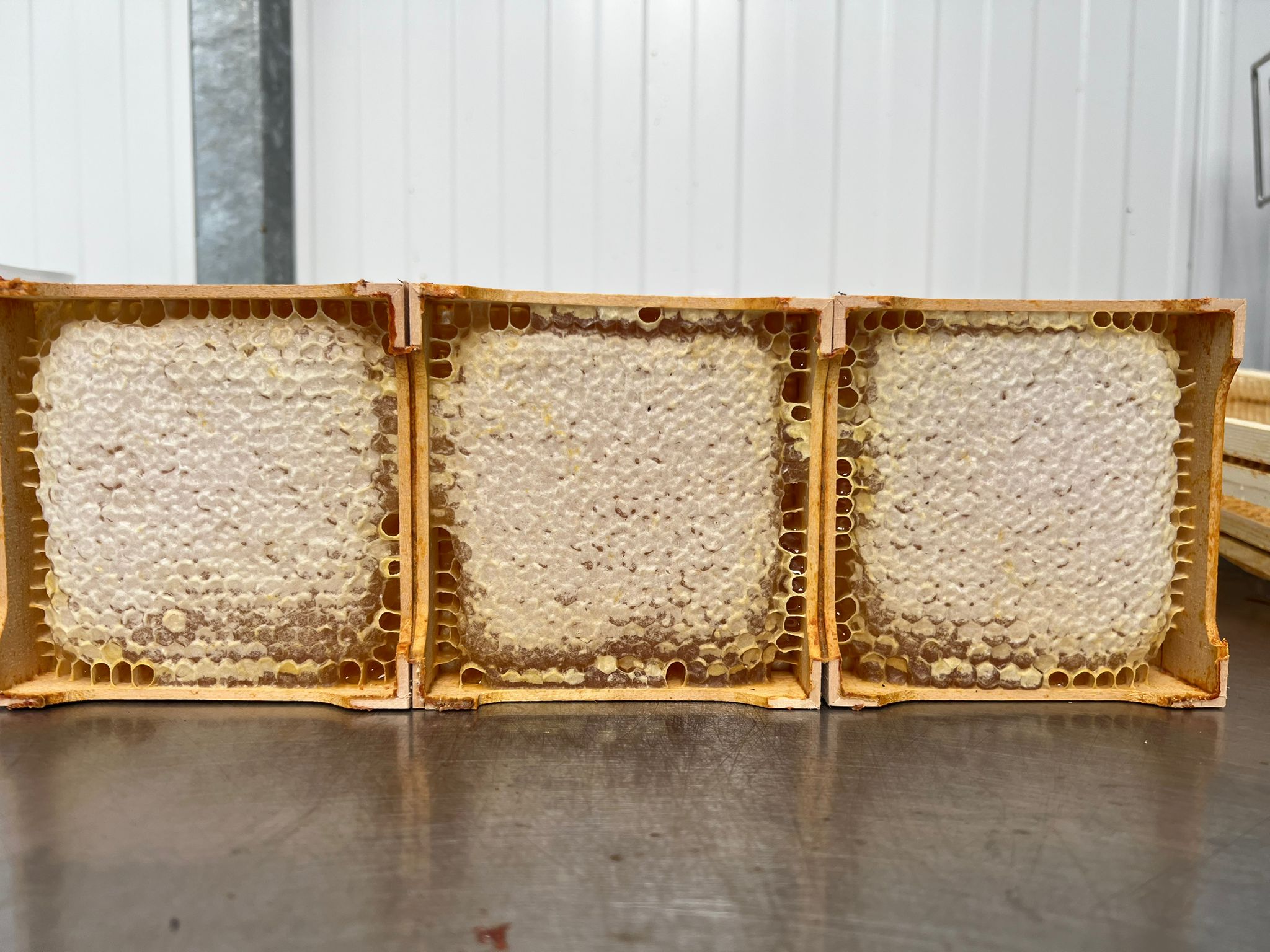
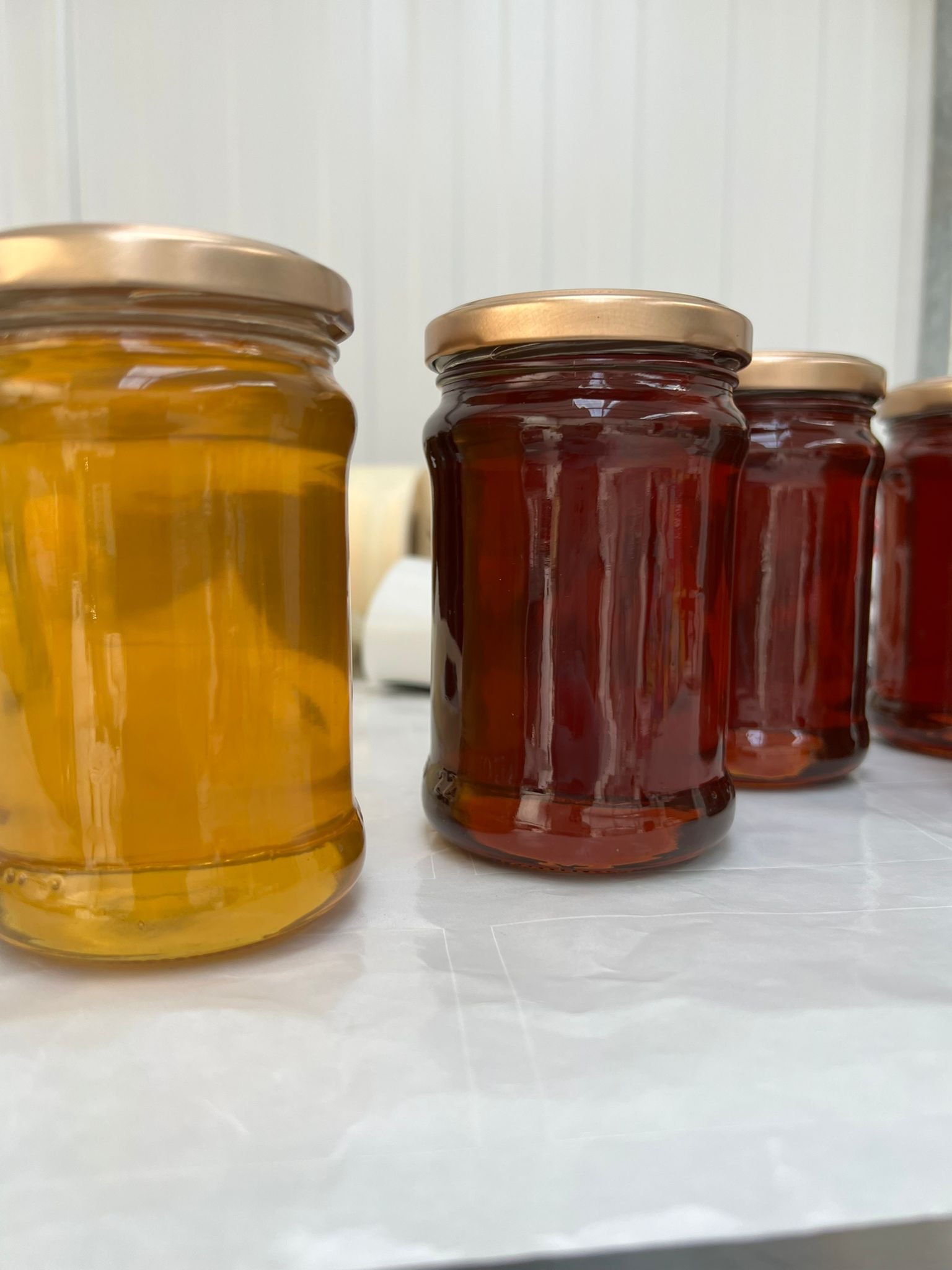
When someone picks up a jar of Soft Set alongside the Clear honey at a market stall, the question I hear most is: are these the same honey? They are. Same bees on the Cooley Peninsula, same flowers, same batch of raw nectar worked into honey in the hive. The difference between the two jars is not what is in them - it is what happens after extraction, and specifically what happens to the crystals.
Here is how the two honeys from my range sit alongside each other, and how to decide which one belongs in your kitchen.
What runny honey actually is
My Clear honey is the jar most people picture when they think of honey: golden, pourable, liquid in the light. It comes from wildflowers across the Cooley Peninsula - hedgerow blossom, field flowers, whatever is coming into season through late spring and summer above Carlingford Lough.
Raw honey is always a supersaturated sugar solution. It contains far more dissolved sugars - mainly glucose and fructose - than water can comfortably hold at room temperature. That means it wants to crystallise. Whether it does so quickly or slowly depends on the ratio of those two sugars and the conditions it is stored in. High-fructose honeys (think acacia, or a light wildflower) stay liquid for months. High-glucose honeys, like ivy, set hard within weeks of leaving the hive.
If you have ever pulled a jar of Clear from the back of a cupboard and found it starting to granulate, that is not a sign anything has gone wrong. It is completely natural behaviour. A gentle warm bath - water no hotter than your hand can hold - will bring it back to liquid without damaging it.
Runny honey pours. That makes it the right tool for certain jobs: drizzling over porridge, dissolving into a warm drink, running over yoghurt, using in a dressing or a glaze. Anywhere you want it to flow or disappear into something else, clear and liquid is what you reach for.
What soft set honey is - and is not
Soft set honey is not a different product. It is not a flavoured honey, it is not a blend, and nothing is added to it. It is raw wildflower honey from the same Cooley Peninsula landscape as the Clear jar, guided into a different crystal structure.
Here is how it works. All honey will eventually crystallise on its own, but when it does so unaided the crystals that form can be large and uneven - gritty on the tongue, separated into a layer of hard set on the bottom and liquid on top. Soft set honey is made by seeding the liquid honey with a small quantity of very finely crystallised honey - around 10% by weight - then keeping it at a cool, stable temperature (around 14 degrees Celsius) while it slowly sets. The fine seed crystals act as a template. Instead of a handful of large, coarse crystals forming at random, thousands of tiny crystals form uniformly throughout the batch. The result is a smooth, pale, spreadable honey with a texture closer to soft butter than to sugar.
The process was first documented systematically by a Canadian beekeeper named Elton Dyce in the 1930s, though beekeepers had been working with similar ideas before that. The principle is simple: control the crystallisation rather than letting it happen by accident, and you get something far more consistent and pleasant.
It is the same honey in both jars - same nectar, same batch. Only the crystal structure has changed.
How they feel and taste different
The texture difference is real and worth knowing about before you choose.
Clear honey is liquid and immediate. You taste it in full the moment it hits the tongue. It has a clean sweetness with whatever floral character is underneath - in a good raw wildflower honey, that is something distinct and worth paying attention to.
Soft set honey releases more slowly. The crystals melt on the tongue and the flavour unfolds in a slightly different way - many people find it richer-feeling, even though the honey itself is identical. It sits on food rather than running off it. On toast, it stays where you put it. On warm scones, it melts just enough to coat without vanishing. Stirred through warm porridge, it dissolves smoothly.
Neither is better. They are different tools for different moments.
When to use each one
Reach for the Clear jar when:
- You are drizzling over something (cheese, yoghurt, fruit, warm bread)
- You need it to blend into a drink or a dressing without leaving texture
- You are making a simple vinaigrette or a sauce that needs to emulsify
- You want the colour - that amber pour catching the light
Reach for the Soft Set jar when:
- You want to spread it like butter, on toast, crackers, or warm soda bread
- You are putting it on porridge or overnight oats and want it to sit on top rather than sink
- You are packing something for a picnic or taking it travelling - no drips, no leaks
- You want it straight from the spoon, where the melting texture is part of the pleasure
A note on baking: because soft set honey has already been crystallised, it behaves slightly differently from liquid honey in recipes. For anything where you are measuring and mixing, the Clear jar tends to be easier to work with. That said, soft set honey melts readily when stirred into something warm - so for porridge, for glazing roasted root vegetables, or for whisking into a warm honey-and-mustard dressing, it works perfectly well.
How my Soft Set is different from the range
It helps to see the Soft Set in context of the other three jarred honeys.
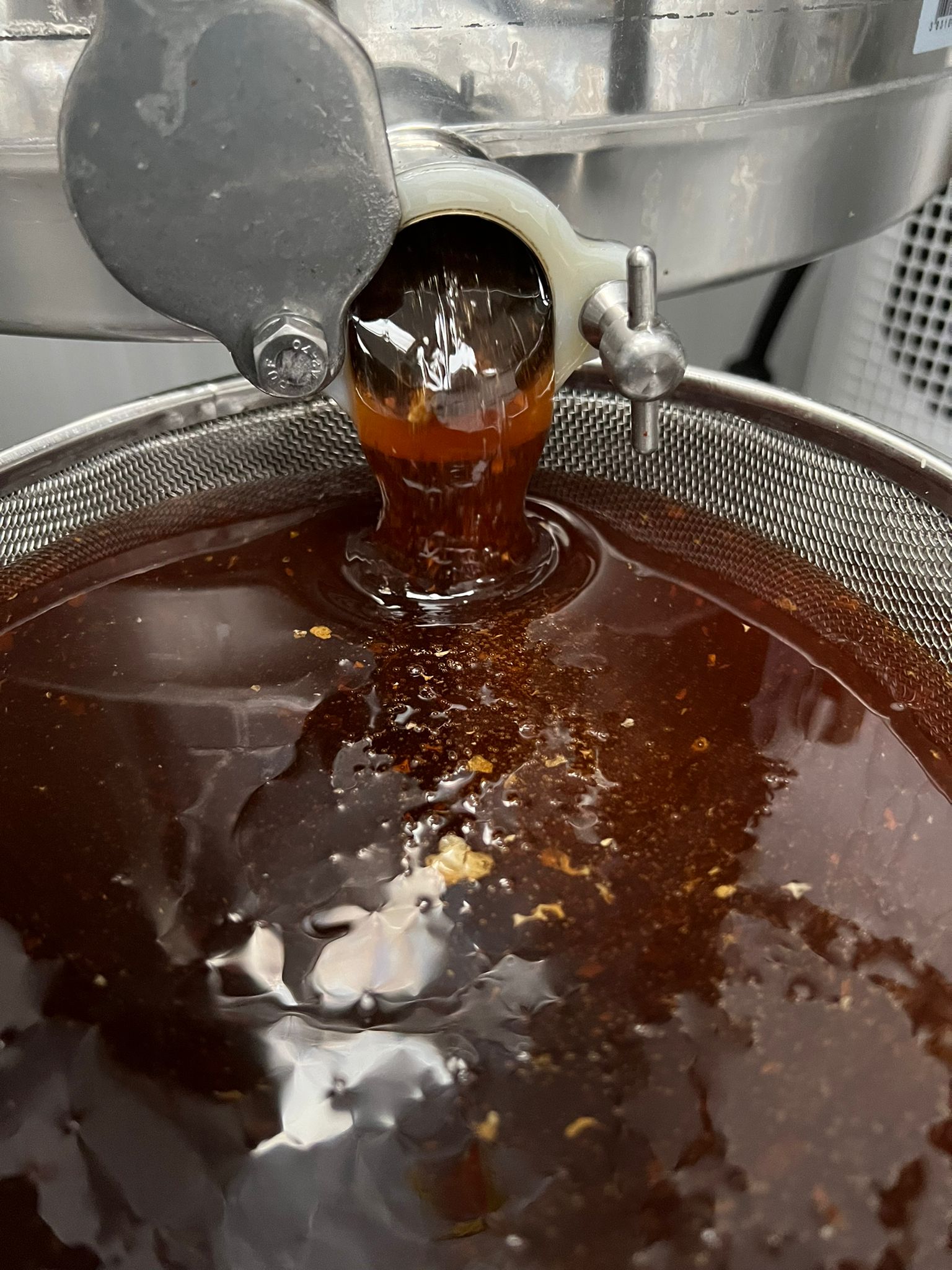
My Heather honey sets to a thick, jelly-like consistency on its own - that is a characteristic of ling heather nectar (Calluna vulgaris), which contains a protein that creates a thixotropic set (it firms when still, loosens when stirred). It does not pour at all and it is not soft set in the controlled-crystallisation sense. The Heather jar is its own thing: bold, aromatic, harvested from the mountain slopes above Carlingford Lough in late summer.
Ivy honey sets hard and pale very quickly after extraction - ivy nectar is high in glucose and crystallises fast without any intervention from me. The ivy harvest comes in autumn, and the honey goes from liquid to a firm, pale solid within weeks. If you like a hard set honey with a mild, slightly menthol character, the Ivy jar is the one to try.
The Soft Set sits between these two. It has the spreadable, creamy consistency that comes from controlled seeding - smooth, no grittiness, mild and full-flavoured. The Soft Set jar is the one I would suggest to anyone who finds runny honey a bit messy in daily use, or who simply prefers something they can spread.
If you are not sure which one to start with, the post which honey should you try first might help you narrow it down.
FAQ
Is soft set honey raw?
Yes - if it has been made properly, without heating the honey above the temperatures that would damage it. My Soft Set is raw, unheated, and unblended, seeded and set at cool temperatures. The batch number and harvest date on the label are the same assurance you get on every jar from this apiary.
Why does soft set honey sometimes go hard in the jar?
If it gets very cold - stored in a cold pantry or near a window in winter - the crystals can tighten and the texture firms up. A few minutes at room temperature usually softens it again. Unlike runny honey, you do not need to warm it in water; just leave it out.
Can I use soft set honey in baking?
Yes, though clear honey is easier to measure and mix. Soft set melts readily when added to something warm, so it works well stirred through porridge, drizzled over roasted vegetables fresh from the oven, or whisked into warm dressings. For cakes and bread where you need to measure exactly, clear honey is less fuss.
Is soft set honey the same as creamed honey?
Yes. Creamed honey, whipped honey, spun honey, churned honey - all of these are names for the same process: seeded, controlled crystallisation that produces a smooth, spreadable set. The name varies by country and producer, but the thing in the jar is the same.
Both Clear and Soft Set are available for local collection from Mullabane, Carlingford, and at markets in the area. Each jar is batch-numbered and harvest-dated - single-origin, from the Cooley Peninsula. See what is currently available.